
When we launched Evidence Search in January, we solved the first half of the problem: finding the "needle in the haystack" of messy failure reports. But for a Vertical AI, finding the needle isn't enough. You have to know what to do with it.
The Shift: From Passive Search to Active Resolution
Most industrial search tools are passive. They wait for you to type the right word. Tabbird is now an active participant in your engineering workflow, utilizing a new evaluation framework to ensure we surface the best possible outcomes for your design initiatives.
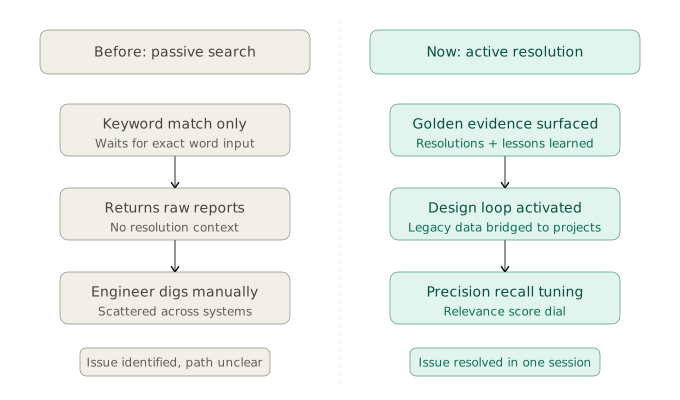
Surfacing "Golden Evidence"
Not all failure reports are created equal. A "Golden" report isn't just one that matches your keywords; it's one that contains the resolution path. Tabbird now prioritizes records that include troubleshooting resolutions and "lessons learned," surfacing the high-value context that tells your engineers how to fix the problem in the next design cycle.
Activating the "Design Loop"
Historical knowledge is only useful if it's reachable. We've refined our mechanical context mapping to bridge the gap between legacy data and current projects. When your team starts a new design initiative, Tabbird activates the collective memory of your organization.
Precision Engineering for Data Recall
We've updated our engine to maximize Recall (finding every relevant piece of evidence) without sacrificing Precision (filtering out the noise). Engineers get a "Relevance Score" that acts as a dial for their investigation.
We're Just Getting Started
Better retrieval doesn't just return better reports — it determines whether an engineering issue is successfully resolved. When a quality engineer asks about a specific component failure, retrieving only the matching claims answers the question but doesn't solve the problem.
Surfacing those records alongside historical knowledge from past troubleshooting resolutions and successful design upgrades gives the team everything they need to resolve the issue and prevent it in future iterations in a single session.
We track this as the Resolution Loop Rate: the percentage of field issues that are successfully mapped to a verified root cause and a design path without the need for manual digging across systems.
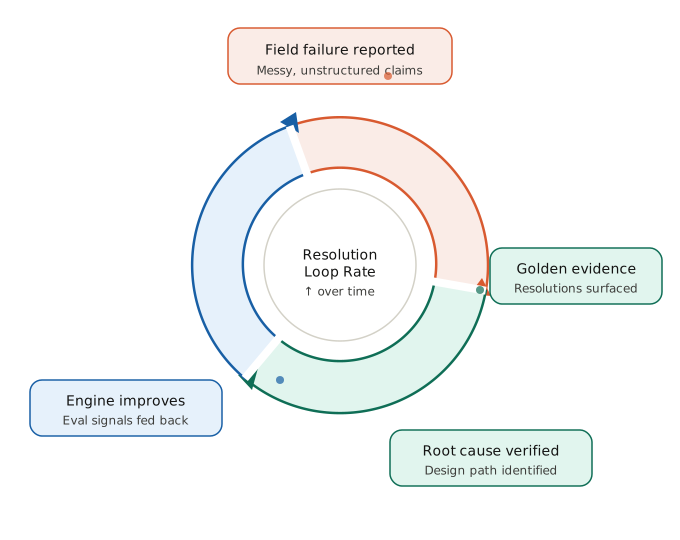
For high-volume industrial teams, even modest retrieval gains translate to stopping financial leakage and measurable improvements in long-term product reliability.
Search for an industrial AI isn't something you build once. By defining "good search" in terms of resolution, generating rigorous evaluation data from real-world engineering context every day, and feeding those signals back into the system, we've built an engine that reliably gets better at closing the gap between failure and fix.
Related posts

Hello, Telemetry Agent
Run diagnostics, across fleets, in minutes
Tabbird AI Agents can now link and analyze telemetry data from connected factories, equipment, and vehicles — so engineers can test a hunch against the whole fleet in minutes, not weeks.
July 8th, 2026

Ending the Prioritization Debate
Are We Fixing the Right Thing?
Prioritization isn't a ranked backlog you sort once — it happens at every technical decision point. Here's how connecting unstructured field claims with fleet telemetry replaces “past experience” with ground truth.
August 28th, 2026