
We built Tabbird because OEM engineering, quality, and supplier teams were spending far too much time manually connecting the dots across data sources when they should have been fixing failures. Today, the need to turn field failure reports and warranty claims into action has never been more urgent.
In 2025, we watched AI agents transform how software gets built and iterated. Now the same shift is coming to physical product improvement, leveraging the data OEMs already collect. Today we're launching Failure Mode Clustering, a feature that fundamentally changes how engineering teams work through field issues, and a glimpse into what modern product improvement looks like.
Failure Mode Clustering: The end of reactive failure analysis.
Today, failure analysis runs on engineers' time and manual effort, one case at a time, digesting records from ERP, MES, CRM, and dealer systems that accumulate far faster than any team can read. Meanwhile:
- Machines stay down
- Production gets interrupted
- Customers get frustrated
- Warranty losses pile up
- Margins quietly disappear
Two things are clear. First, as warranty data scales, manual review becomes the critical bottleneck to prioritizing and resolving issues. Second, unlike a human, AI doesn't need days to read every report individually, it can surface emerging failure patterns across thousands of records in near real time.
So we asked ourselves: if we were starting from scratch, how would we build a system not just to analyze faster, but to act faster? That's what we're introducing today: a re-imagination of failure resolution, built around an engine that finds the signal hidden in piles of unstructured failure reports.
Deeper than symptoms.
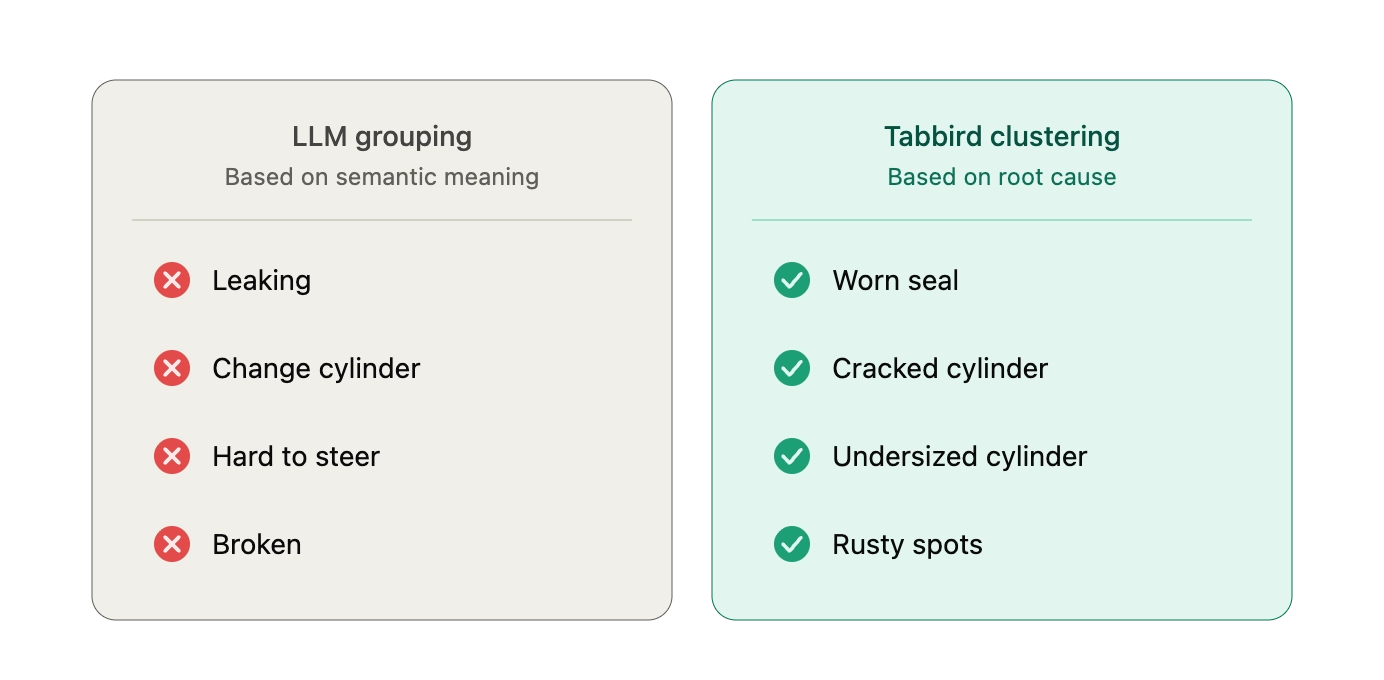
Warranty records are technician repair notes. A field technician might log the same failure as a broken "seal," a "cylinder seal leakage," or a "ram seal failure", different words, same underlying failure mode. Meanwhile, two records using nearly identical words can describe completely different failures.
That's why keyword matching and simple text grouping fall short. Failure Mode Clustering reads field reports the way an experienced engineer would: grouping records by the underlying failure mode, informed by context, subsystem structure, and BOM, not by the most popular words and phrases.
Engineers keep the final say
The AI proposes; your engineers decide. That's not a disclaimer — it's the design.
Every cluster links back to the exact records behind it: the raw claims, the technician comments, all of it. Nothing is hidden, so engineers can validate the grouping record by record. Confirm a cluster, merge two that overlap, split one apart, reclassify individual records — every adjustment refines the output and tailors the system to your product vocabulary.
The result isn't a black-box recommendation. It's an engineer-confirmed failure mode, backed by real claim data — something you can defend in a supplier dispute or a cross-functional review. Failure Mode Clustering is built around engineering judgment, not around replacing it.
From weeks of chaos to same-day containment.
With Failure Mode Clustering, no one sifts through thousands of reports manually. Connect your failure reports, and Tabbird delivers the patterns in minutes: labeled, ranked by record volume, and ready for engineering review.
When failure patterns surface in minutes instead of days, your team can trigger containment before a failure multiplies across the fleet.
That speed changes what's possible downstream, turning weeks of warranty chaos into same-day containment.
Under the hood: compounding knowledge.
Resolving issues quickly is only half the battle. The real value lies in making sure they don't happen again.
Failure Mode Clustering is the foundation for that shift, because it drives and records corrective actions. Over time, this creates a continuous improvement loop: the system surfaces a pattern, the team triggers containment, and every resolution becomes compounding knowledge for the entire organization: institutional memory that outlasts any individual engineer's inbox.
This is the modern product improvement cycle, driven directly by field inputs: proactive, fast, and backed by data. No more endless reading, just swift containment and resolutions that stick.
Try it with your own data.
Failure Mode Clustering is live now. Upload your warranty data, select your failure description column, and see your fleet's failure modes — ready for your review, your refinement, and your action.
Related posts

Hello, Telemetry Agent
Run diagnostics, across fleets, in minutes
Tabbird AI Agents can now link and analyze telemetry data from connected factories, equipment, and vehicles — so engineers can test a hunch against the whole fleet in minutes, not weeks.
July 8th, 2026

Ending the Prioritization Debate
Are We Fixing the Right Thing?
Prioritization isn't a ranked backlog you sort once — it happens at every technical decision point. Here's how connecting unstructured field claims with fleet telemetry replaces “past experience” with ground truth.
August 28th, 2026