
Finding: hydraulic pump pressure is trending 12% below baseline across 8 units in the last 14 days.
Details:
- Affected units: 8 of 42 in fleet segment
- Average deviation: 12.4% below 90-day baseline
- Earliest signal: 14 days before this report
HYDRAULIC PUMP — PRESSURE TREND
Hydraulic pump — 8 units, 14 days · −12.4% vs baseline
Hundreds of engineers are already enjoying the benefit of Tabbird's Clustering AI and Similarity Search processing unstructured datasets, saving hours of work, spotting patterns that happened in the field, and surfacing similar past failures without anyone having to remember where to look.
Despite billions of dollars of investment in conversational AI and coding agents, no one has been able to bring the delight of AI agents to the engineering teams working on hardware development and manufacturing, from devices, to equipment, to vehicles.
That's why today we're excited to announce a new way to abstract insights and take actions with Tabbird: Telemetry Agent.
Tabbird AI Agents can now link and analyze telemetry data from connected factories, equipment, and vehicles.
Run diagnostics, across fleets, in minutes
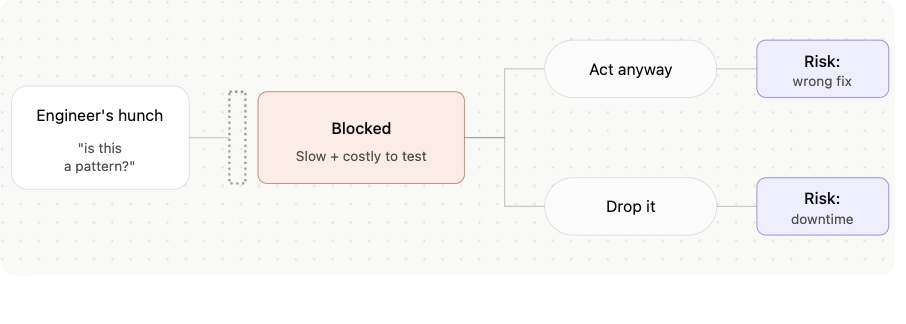
Engineers are good at having hunches. A component seems to be drifting toward failure. Two incidents, on the surface unrelated, feel like they share a cause. The instinct is often right. The problem has never been the instinct. It's testing it.
Confirming a hunch like that rigorously, against real sensor and telematics data, across an entire fleet, has historically meant pulling in a data science team and waiting weeks for an answer most plants don't have the bandwidth to chase down. So the hunch goes one of two ways: it gets acted on without real validation, or it gets quietly dropped. Acting on it risks the wrong fix. Dropping it risks letting a real pattern recur, possibly catastrophically, the way it did for one plant on a Monday that cost an entire shift of production.
Today, we're introducing Telemetry Agent to close that gap.
What it does
Telemetry Agent gives engineering teams a direct way to test their own assumptions against fleet-level sensor and telematics data, without needing to be data scientists to do it. It supports three core analyses:
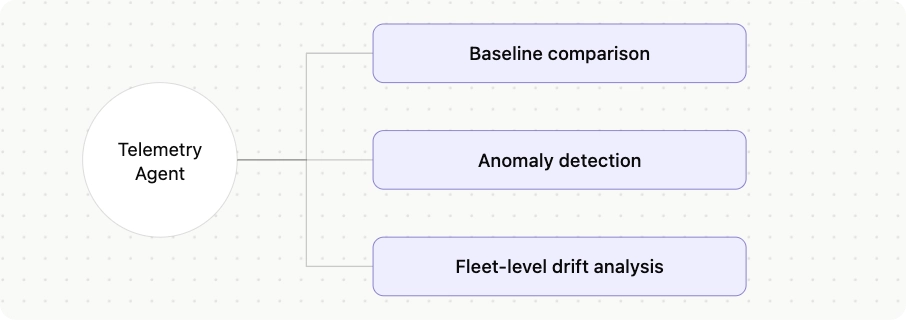
Baseline comparison
Establishes what normal actually looks like for a given component or system, so a deviation is something measurable, not just a feeling.
Anomaly detection
Surfaces the signals that fall outside that baseline early enough to act on before they become a failure.
Component drift analysis at fleet level
Tracks how a component's behavior is trending over time, across an entire fleet, not just the one unit sitting in front of an engineer today.
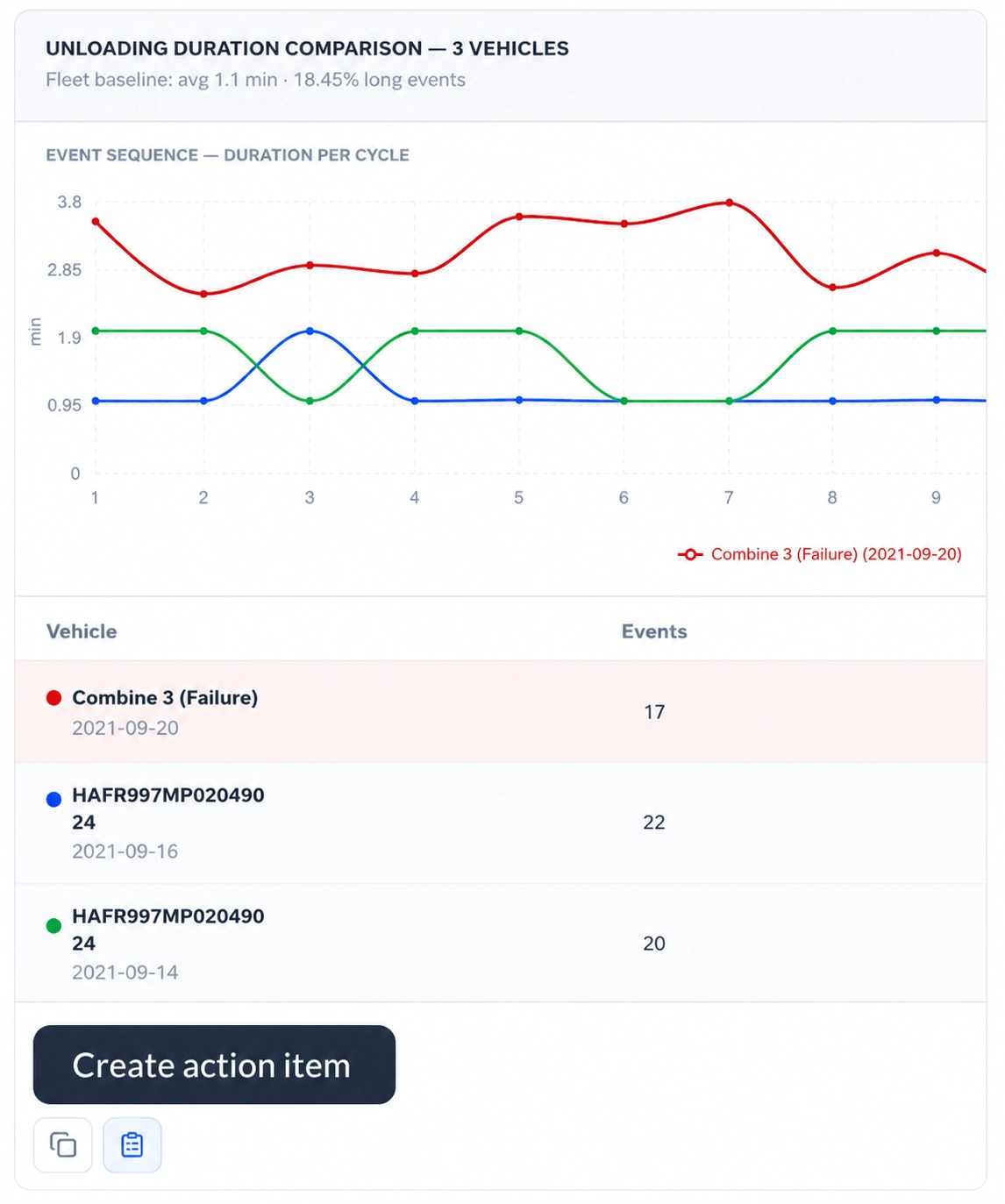
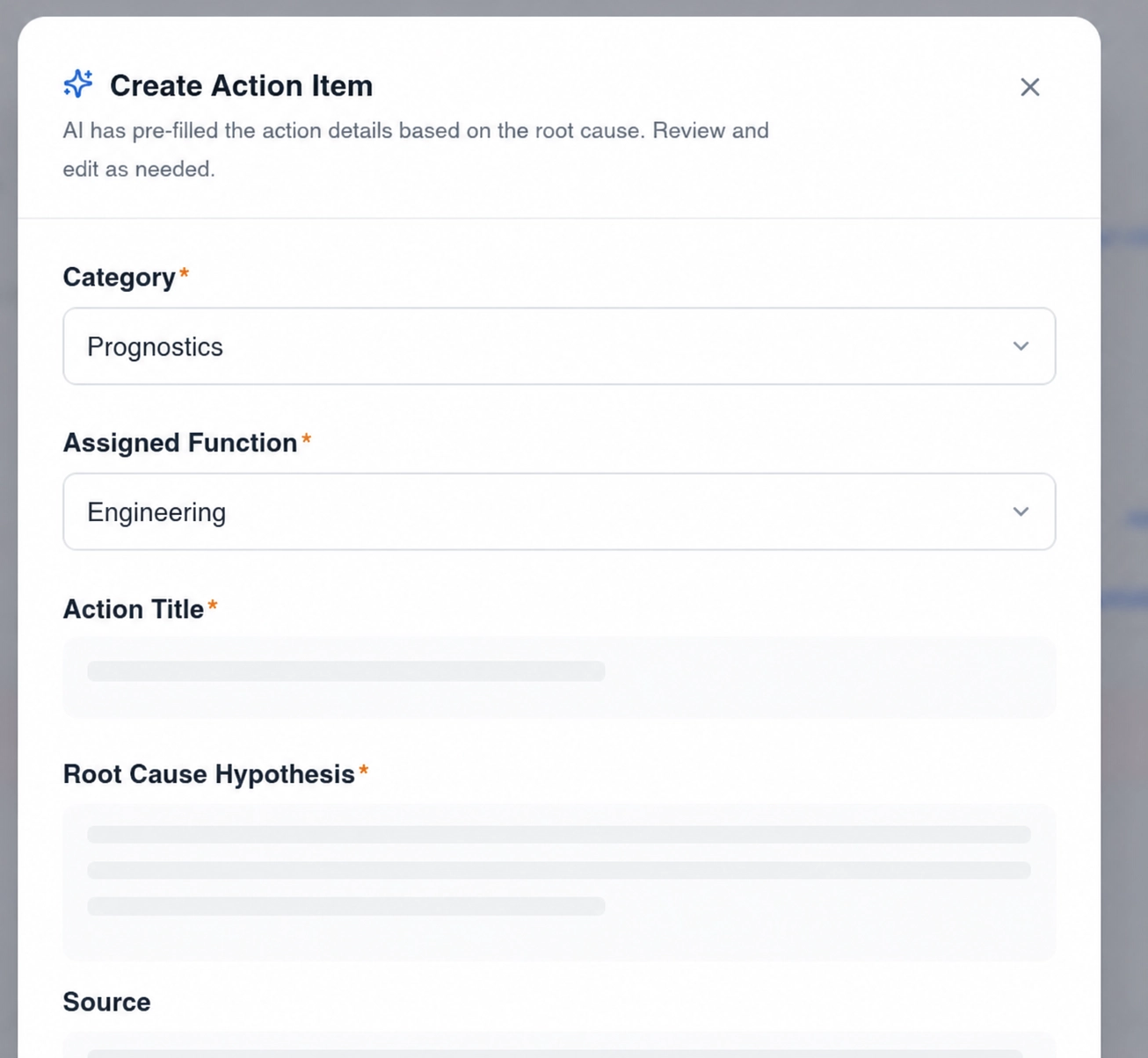
Flag the data gap the moment it shows up: sometimes the answer an engineer needs isn't there at all, a sensor that should be reporting isn't, a signal stops partway through a cycle, a unit is missing the telemetry channel the rest of the fleet has. Telemetry Agent surfaces that gap during the analysis, lets the engineer flag it and open a ticket on the spot, and attaches the cost impact behind it, the warranty exposure, the downtime risk, the cost of flying blind on that unit. That dollar figure is what turns a missing data point from a known annoyance into something a team can actually prioritize against everything else competing for their time.
Why this matters now
The equipment running your factories is monitored. The vehicles in your field are connected. Sensor data is abundant, more abundant than most teams have the bandwidth to use, sitting there waiting to enable proactive action instead of reactive cleanup.
What's been missing isn't the data. It's a way to put it to work without routing every question through a data science team. Telemetry Agent isn't a BI dashboard. It's an AI agent that takes the diagnostic instincts one experienced engineer has built up over years, baseline comparison, anomaly detection, drift analysis, and encodes that expertise into a workflow the whole team can run themselves, on demand, against the entire fleet.
An assumption that used to take weeks and a specialist team to validate can now be checked directly by the engineer who had it, at the scale of the whole fleet rather than a single unit.
The hunch doesn't have to be acted on unvalidated, and it doesn't have to be dropped for lack of time. It gets validated, fast.
Built for the floor, not the lab
Telemetry Agent isn't a separate analytics dashboard engineers have to learn on top of everything else. It's designed to slot into the investigation they're already running, surfacing baseline, anomaly, and drift signals at the point where an engineer is actually asking "is this really a pattern, or am I imagining it." Every result stays traceable back to the underlying sensor data it came from, so a finding can be checked, not just trusted on faith.
The real components of an AI agent, and what each one means for your team
This is one piece of a larger idea we've been building toward: that the gap between data a plant captures and decisions a team can act on with confidence is closeable, stage by stage. Telemetry Agent closes it for sensor and telematics data specifically. In the next piece, we'll look at how the rest of the platform does the same for the unstructured side, the failure reports, inspection notes, and technician write-ups that make up most of what a plant actually records, and how that connects back to what Telemetry Agent finds.
If you work on improving product quality and reliability at an equipment OEM and want to see what a 10-minute investigation cycle looks like, reach out.
Related posts

Ending the Prioritization Debate
Are We Fixing the Right Thing?
Prioritization isn't a ranked backlog you sort once — it happens at every technical decision point. Here's how connecting unstructured field claims with fleet telemetry replaces “past experience” with ground truth.
August 28th, 2026
The Gap on the Factory Floor
From Data to Decisions: Hours, gone, and still no answer
Plants aren't data-poor — they're decision-poor. The gap isn't how much data a plant captures, but how much of it a team can turn into a confident decision.
May 23rd, 2026