
When a machine fails in the field, the immediate pressure is to get it running again. Months later, when the same failure comes back, engineering leadership is forced to ask a harder question: Did we change the design to fix the root cause, or did we patch the symptom we understood best?
No failure is simple. A field failure almost always has several contributing causes: a component spec, a supplier lot, an assembly step, a duty cycle nobody planned for. When engineering teams lock themselves in a room to debate "effort versus ROI," they are really arguing about where to spend a finite number of engineering hours. Leaders lose sleep over whether those hours went to the right cause. The teams doing the work spend their energy defending the call they made.
The trap of "past experience"
These debates happen for a simple reason: nobody has an easy way to digest everything tied to a known failure. Warranty claims, technician notes, service logs, telemetry, build records and supplier changes all live in different places. So engineers do what capable people do with incomplete information. They make a judgment call from past experience.
Past experience is valuable, but it has a bias. It pulls teams toward the failure they have seen before, not the one costing the most today.
Most organizations also treat prioritization as a ranked list or a backlog score. That helps you pick the first failure mode to open. It does nothing at the next fork: which cluster of complaints is actually one root cause, whether the field data supports the hypothesis, or how many units share the condition. Prioritization has to happen at every technical decision point, not once at the top.
Defending engineering ROI with ground truth
At Tabbird, we built a troubleshooting workflow that puts the right evidence at each of those decision points, so the debate is about the data rather than about whose memory is better.
Quantifying the unstructured
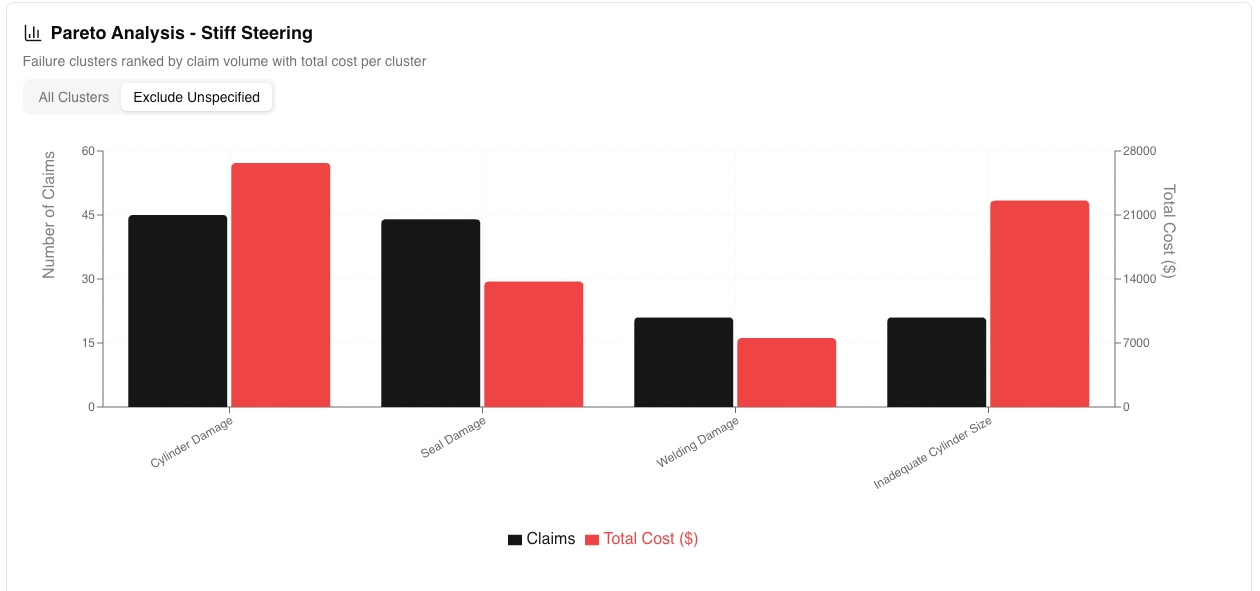
Context is usually buried in technician notes and service narratives. Our clustering AI reads that text and groups claims into actual failure patterns rather than the part-number buckets the warranty system assigned. A histogram view shows which clusters are growing, which are fading, and which are draining the most time and money.
Validating with telemetry
Once you drill into a high-priority cluster, Tabbird's telemetry agents process time-series sensor data across the fleet to answer two questions: does the operating data actually support the technical assumption, and how many units share that condition? The map below shows the units impacted by a validated cause and the ones already on a fix path and expected to recover.
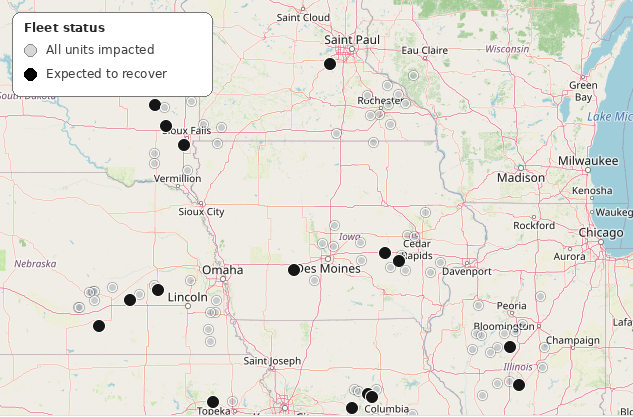
Instead of hoping a design update solves the problem, you can size the customer and business impact before committing engineering hours, then confirm that the fix addresses what the machine is physically doing in the field.
By connecting unstructured field claims with hard telemetry data, your team spends less time arguing about what to work on next and more time on fixes you can show paid off.
If you lead product quality or reliability at an equipment OEM and want to see what this looks like on your own claims, reach out.
Related posts

Hello, Telemetry Agent
Run diagnostics, across fleets, in minutes
Tabbird AI Agents can now link and analyze telemetry data from connected factories, equipment, and vehicles — so engineers can test a hunch against the whole fleet in minutes, not weeks.
July 8th, 2026

The Gap on the Factory Floor
From Data to Decisions: Hours, gone, and still no answer
Plants aren't data-poor — they're decision-poor. The gap isn't how much data a plant captures, but how much of it a team can turn into a confident decision.
May 23rd, 2026